

3D Printing Materials Market Outlook: North America Leads Additive Manufacturing with Stratasys, 3D Systems & BASF
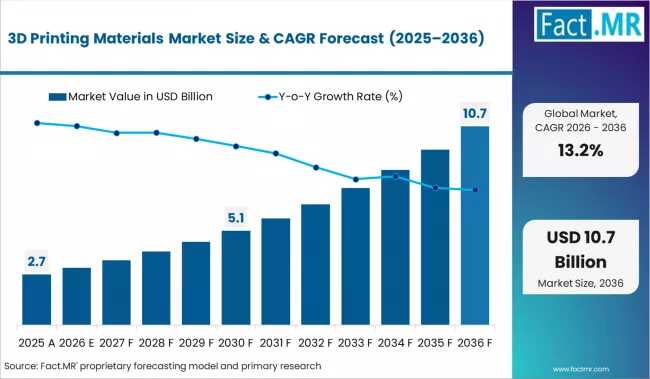
3D Printing Material Market Size
This growth is driven by increasing adoption across aerospace, healthcare, and automotive sectors, where lightweighting, customization, and supply chain optimization are critical. The transition toward certified, high-performance materials is redefining supplier strategies, pricing models, and industrial adoption.
Get detailed market forecasts, competitive benchmarking, and pricing trends: https://www.factmr.com/connectus/sample?flag=S&rep_id=5863
Quick Stats
Market Size (2025): USD 2.8 Billion
Market Size (2026): USD 3.1 Billion
Forecast Value (2036): USD 11.1 Billion
CAGR (2026–2036): 13.2%
Incremental Opportunity: USD 8.0 Billion
Leading Segment: Plastics (48–50% share)
Leading Region: Asia-Pacific
Key Players: BASF SE, Stratasys Ltd, Arkema S.A., Evonik Industries AG, 3D Systems Corporation
Executive Insight for Decision Makers
The market is shifting from volume-driven commodity materials to performance-driven specialty materials.
Strategic Shift:
Demand is increasingly concentrated in engineered polymers and metal powders used in certified industrial applications.
What Industry Leaders Must Do:
Invest in material certification and compliance
Develop application-specific materials
Build ecosystem partnerships with printer manufacturers
Risk of Inaction:
Companies focusing only on low-cost materials risk margin erosion, loss of industrial clients, and exclusion from high-value sectors like aerospace and medical devices.
Market Dynamics
Key Growth Drivers
Industrial adoption of additive manufacturing in aerospace and automotive
Rising demand for biocompatible and customized medical materials
Lightweighting trends in automotive and defense sectors
Government support for advanced manufacturing technologies
Key Restraints
High material certification and qualification costs
Lack of standardization across printing technologies
Volatility in raw material pricing (polymers, metal powders)
Emerging Trends
Shift toward bio-based and sustainable materials
Growth of metal additive manufacturing for end-use parts
Integration of AI-driven material optimization
Increasing use of composite and hybrid materials
Segment Analysis
Leading Segment:
Plastics dominate with 48–50% share due to cost efficiency, ease of processing, and compatibility with FDM technology.
Fastest-Growing Segment:
Metal powders, driven by aerospace and defense applications requiring high strength and thermal resistance.
By Form:
Filament leads with 68–70% share
Powder and resin gaining traction in industrial applications
By Application:
Aerospace & industrial manufacturing: fastest growth
Healthcare: high-value niche segment
Strategic Insight:
High-performance materials are becoming margin drivers, while commodity materials face pricing pressure.
Supply Chain Analysis (Critical Insight)
Value Chain Structure
Raw Material Suppliers
Petrochemical companies (polymers)
Metal mining and refining firms (titanium, aluminum powders)
Material Manufacturers
Specialty chemical companies producing filaments, powders, and resins
Distributors & Integrators
Industrial distributors and AM service providers
Printer OEM partnerships ensure compatibility
End-Users
Aerospace OEMs → metal powders
Healthcare firms → biocompatible polymers
Automotive → engineering plastics
Who Supplies Whom
Chemical companies supply feedstock to material processors
Material producers collaborate with printer manufacturers
Certified materials are sold to industrial OEMs and service bureaus
Key Insight:
Once a material is validated within a production workflow, switching costs are high—creating long-term supplier lock-in and stable demand streams.
Pricing Trends
Commodity vs Premium:
Standard thermoplastics → price-sensitive, competitive
Engineered polymers & metal powders → premium pricing
Key Pricing Drivers:
Raw material costs
Certification and compliance requirements
Application-specific performance needs
Supply-demand imbalance
Margin Insight:
Advanced materials offer higher margins despite lower volumes, driving supplier profitability.
Regional Analysis
Top Countries by CAGR (2026–2036)
India: 10.6% – Government-backed additive manufacturing initiatives
China: 10.4% – Large-scale industrial deployment
United States: 9.8% – Aerospace and healthcare demand
Japan: 9.4% – Precision manufacturing adoption
Germany: 9.1% – Industry 4.0 integration
Regional Insights
Asia-Pacific: Fastest-growing, driven by manufacturing expansion and policy support
North America: High-value market focused on aerospace and defense
Europe: Innovation hub with strict regulatory standards
Developed vs Emerging Markets
Developed markets → focus on high-performance materials
Emerging markets → growth driven by volume adoption and industrial expansion
Competitive Landscape
Market Structure: Moderately fragmented with strong specialization
Key Players:
BASF SE
Arkema S.A.
Stratasys Ltd
Evonik Industries AG
3D Systems Corporation
Materialise NV
Sandvik AB
EOS GmbH
Competitive Strategies
Development of application-specific materials
Strategic partnerships with printer OEMs
Expansion of production capacity
Focus on sustainability and bio-based materials
Strategic Takeaways
For Manufacturers
Focus on certified, high-performance materials
Build long-term partnerships with industrial clients
For Investors
Target companies in metal powders and specialty polymers
Monitor firms with strong IP and certification capabilities
For Marketers & Distributors
Position products based on application-specific value
Strengthen presence in industrial ecosystems
Future Outlook
The market is expected to evolve toward industrial-grade, certified materials, with increasing adoption in end-use production.
Strong impact of automation and AI in material development
Rising importance of sustainability and circular materials
Expansion of localized production ecosystems
Long-term growth will be driven by the integration of additive manufacturing into mainstream industrial supply chains.
Conclusion
The global 3D printing materials market is transitioning into a high-value, performance-driven ecosystem. As industries increasingly adopt additive manufacturing for production applications, demand for certified and advanced materials will accelerate.
Companies that invest in innovation, certification, and ecosystem integration will be best positioned to capture long-term growth opportunities.
Why This Market Matters
This market sits at the intersection of advanced manufacturing, digital transformation, and material science innovation. Its evolution will directly influence how industries design, produce, and distribute products in the future.
Full Report: Unlock 360° insights for strategic decision making and investment planning-https://www.factmr.com/checkout/5863
Related Fact.MR Reports
3D Printing Plastics Market https://www.factmr.com/report/3796/3d-printing-plastics-market
3D Printing Material Market https://www.factmr.com/report/3d-printing-materials-market
Plant Oil Based Printing Inks Market https://www.factmr.com/report/plant-oil-based-printing-inks-market
Thin Printing Paper Market https://www.factmr.com/report/thin-printing-paper-market
Digital Textile Printing Ink Market https://www.factmr.com/report/digital-textile-printing-inks-market
S. N. Jha
Fact.MR
+1 628-251-1583
email us here
Legal Disclaimer:
EIN Presswire provides this news content "as is" without warranty of any kind. We do not accept any responsibility or liability for the accuracy, content, images, videos, licenses, completeness, legality, or reliability of the information contained in this article. If you have any complaints or copyright issues related to this article, kindly contact the author above.
